Showing posts with label Training Tip. Show all posts

Friday, September 14, 2012

The Coach's Role

Ok I'm only joking, this post is not about a handbag


So this article comes to you after much thought and provocation. A couple of weeks ago I had, well… a little tiff with another trainer and while my behavior was in the wrong, I felt that my points were valid and correct and so I couldn’t let it go. I feel the need to publicly state my thoughts and feelings on the subject, even though this particular individual will never read them (which is probably a good thing). So here I am getting up on my soap box for you all to read. Hopefully you will use your own judgment whether I am correct or not.

I am sure you are now curious to what we argued about, well this individual and I did not see eye to eye on a certain fitness program. While the program was the subject, my real annoyance was and is concerning the role of a coach, personal trainer, or group fitness instructor.

Before I begin its important that I make these notes, while each of the three individuals above are different, they all should have the same principles guiding them and most of my thoughts and ideas will apply to all three individuals. For that reason to keep things simpler I will refer to these three different roles as your trainer.

The Background of the Argument

After spending the last 5 years in school learning about exercise physiology, psychology and coaching I have to say that I have built a pretty high standard for myself and for other trainers (and a really high soap box). And after years of studying and working hard to do things “the right way” it is a tad bothersome to see trainers and coaches out there who do not give a crap (pardon my language) what’s the best way or even a good way and as a result, their clients do not learn anything except bad habits, motives, and information. Now before you all start jumping down my throat please don’t misunderstand me. I recognize there are A LOT of really good trainers out there and that everyone, every trainer, including myself makes mistakes and they do not know everything. I will be the first to admit that I am not yet a great coach. I think it takes time, experience and education to make a truly great coach. But even with my limited (2+ years) working as an instructor, coach and now a personal trainer I still can’t help be shocked at some of the things I hear and see.

Below I have compiled a list of 10 traits and roles that I believe you should expect to see in a “quality” coach and which will hopefully help you decide who you want to be your trainer. These are traits and behaviors that are based on experience as well as formal training and common sense. I will attempt to illustrate with both “imaginary” as well as real life examples while trying to be sensitive to those who are doing the best they can. Please read through the items and consider them, not as hardened rules but as tools to guide you as you next work with your trainer, or as you seek to find a new trainer.
I know this is quite lengthy and I do apologize for that! But hopefully you will find it worth your time.

* Not all of the items I have listed will be relevant to every coach or every instructor, for example, a group class instructor will not be able to create the same individuality in a class as a one-on-one lesson with a trainer.

Your coach/trainer should:
 
1.       Seek as much formal education, experience and training they can within their respective areas of training. Including maintaining any certifications that are appropriate.
A while back I went in to certify as an indoor cycling instructor. During which a conversation broke out among a few of us instructor-wannabes on a controversial topic, which is better, experience or education. I for one am a big fan of having formal training, credible certifications as well as experience. In case you are unaware there are many training and coaching certs that only require you to pass an exam, no formal training or education needed. Some certs however require formal education (bachelors or higher) in exercise science by an accredited university. See www.acsm.org and www.nsca.org for examples.
One of the other instructors had the opinion that formal education didn’t make a big difference whether you were a good personal trainer or not because you could learn all you needed to with experience. I couldn’t have agreed and disagreed with her more, based on her experience of watching trainers with bachelors who didn’t exactly come off the block running. My response was simply this; it’s true, it doesn’t take a rocket scientist to tell a healthy individual how to lift a weight up and down 12 times, or how to use a treadmill. In fact, helping someone lose weight or gain strength doesn’t require a hard and fast understanding of all of the below the skin information that I have gained. And since training is as much an art as it is a science there will be many trainers who lack all formal education but are incredibly successful because they are gifted artists.
From personal experience I contend that without the deeper knowledge all your trainer can give you is the surface training. And as long as you fit the mold of their previous experience you will do just fine. However, if you do not fit the mold (ie. disease, injury, highly competitive athlete) these trainers will struggle a lot more to get you where you need to go.
2.       Improve their own knowledge and ability through continuing education and by broadening their own horizons through learning new skills or observing other types of training and education.
      In case you aren’t aware I am a certified Tri coach, yoga instructor, cycling instructor, personal trainer, on top of having a bachelor’s degree in Fitness Leadership and working on a masters in Exercise Physiology. Josh (my husband) thinks I just like to spend money. But the real reason for all of the certifications is that I like learning, and each class and training has made me a better trainer and I think, has given me a broader perspective on health and fitness. It’s a shame to see trainers/coaches that think there is only one way to get fit. No, I do not think every trainer needs to have multiple certifications, in fact its better to specialize in one area, however they should at least be trying and learning new things that will help them train you.
       Not to mention, many certification programs out there (most of mine do anyway) require continuing education credits (CEC’s). CEC’s basically assure that I am staying on top of my game.
3.       Follow guidelines for training set by their certifying body, national guidelines and those established by their respective training facility.
There’s a reason why some exercises, techniques, and styles of training are NOT recommended and go in and out of style quickly. Most often its due to the benefit/risk ratio of participating in that activity. Don’t get me wrong, every activity has its risks, but when performed correctly according to guidelines it helps to decrease the odds of injury. Take biking for example, there are many many “wrong” ways to bike, like not wearing a helmet, biking against traffic, or in an indoor class trying to lift weights while biking. Believe it or not there are nationally recognized governing agencies that release guidelines that tell you the safest way to bike based on research as well as experience. 
 
When your trainer knows and follows these guidelines they will be able to not only increase safety, but also improve your training efficiency.
4.       Provide you with quality, up-to-date information that is founded on scientific information as well as experience.
Ever heard of the “fat burning zone”? It’s a myth. What about that lactic acid causes soreness? Also a myth. Ever seen this add “7 old tricks to lose weight quick”? More than likely a load of crap. 
It doesn’t matter where you go someone or some company is looking to get rich off of your naiveté by pushing their gimmicks down your throat. When I see those ads the only thing I can think of is a big old lazy lion lying in the grass waiting to pounce on its unsuspecting prey. Why do you think every week/month there’s a new fabulous, guaranteed fix to your problem? Well… could it be that the 1,000 tips before it didn’t work??? Hmmm…. 


There is a lot of bogus info out there, and while some may be harmless, some bad info can be dangerous (have you heard of phen phen?). In a day with as much information at our finger tips you can’t assume that everyone out there writing articles in your favorite health magazine actually know what they are talking about, same thing for your trainer. I’m having recall error here, but I believe that it is estimated that every minute a new research article is being published. That means that your trainer needs to stay up to date. 
 
 
5.       Know how to “periodize” a training plan which involves knowing how to manipulate intensity as well as the training/recovery balance.* 
Example of a periodized plan. Notice the high and low volume weeks during the "taper" phase.
As an endurance athlete there are 4 main phases to my training program in a year, base phase, endurance phase, speed/strength phase and race skills phase. Yet somehow each year I get stuck in the endurance phase and never seem to move past it. You wonder why I’m still the same pace as I was last year? However I can say this for myself, I make sure to take adequate recovery between hard workouts as well as after severe increases in training load. 
Experience and research have shown that using a structured, progressive training plan (ie periodized program) that uses different phases of training and a variety of intensities while allowing for adequate recovery will optimize results and improve efficiency. 
*This is much harder to do in group classes at the gym where you have people who attend rather inconsistently. 
6.       Create programs that are about YOU (not them) and help you meet your goals. 
Have you ever met with the trainer on the very first day and they already have a program written for you? Or maybe, they give you a program that really isn’t what you need or wanted. Well… then you are probably a victim of the “canned approach”.  I’m sure you’ve all heard of the “canned approach” in case you haven’t basically it’s the “one size fits all” of training programs. In the health and wellness world that can be all too common.
However, worse than being canned is being caught on the wrong end of the Ego. I can’t tell you how many stories I’ve heard of coaches/trainers pushing their clients to become THEIR success story, which in the end drives the athlete out of the sport entirely. 
7.       Minimize inherent risks as well as warn and advise concerning the risks that are inherent to the sport, but perhaps not always controllable.
I want you to look subjectively at the picture below. What are your first thoughts? Are they “wow those guys are so tough” or is it more along my line of thought “Oh my HELL (pardon my thought) what are these idiots thinking???” My guess is you probably thought more along the lines of the first statement, and that’s fine. In fact, that is exactly why the trainers and coaches devised this exercise, to look and be tough. So now you’re probably wondering why I would think the way I do. I suppose its because I take safety very seriously and anyone willing to let someone else “run/walk” with a barbell with that much weight on it is clearly not considering safety. 
Photo: Check out this gallery of great photos featured on the Affiliate Blog

http://community.crossfit.com/gallery/2012-affiliate-blog-photos
The barbell mile... aka run/walk a mile with the barbell and some serious weight.
Here’s what I see wrong with this picture. I see someone putting their body to the maximum test of fatigue and strength in a way that is compromising to their joints (spine and knees) and without any spotters or assistance. They are in the dangerous position that one misplaced step could land them in crutches or in the extreme case a wheel chair. I’ve heard a trainer try to justify using a barbell for this exercise by saying “it’s the same thing as doing squats”. To them I say “you’re lying to yourself”. First of all with squats, particularly back squats, you should always have a spotter, in case you get stuck. Not to mention, typical weight lifting you might do anywhere from 5-20 reps at one time with rest in between and then maybe repeat that 3+ times so that you are able to hold proper form. It’s nowhere near the same impact. Giving the benefit of the doubt, lets estimate it takes them 11 minutes to do a mile, at that slow rate 120/min or approximately 1,320 steps. Now if I was a bio mechanist I could then calculate the force and impact each step has on the body and while I can’t give you the exact number it’s a lot, and it’s enough to be concerned about the impact on the spine (compressed disks?) as well as the meniscus in the knee.  This is a big problem, particularly since the goal of the exercise is to take you to extreme fatigue. Once your main muscles start to fatigue form and technique go out the window, which with that much weight could ultimately lead to injury. 
The other excuse that this trainer handed me was that every sport has its risks, well true, but shouldn’t you do everything you can to minimize those risks? For example, rock climbing can be very dangerous, especially with increasing difficulties. So while these people are not going to quit, they have done what they can to minimize the risk (e.g. using proper equipment and a trusted belayer). Well… there are many ways to still have the alter ego and eat your cake too. You could use a back pack, give piggy back rides, use resistance belts, pull sleds, carry a dead body, etc. In case you aren’t sure why this is so unsafe there are 2 main reasons. 1. The hands are occupied holding onto the weight behind your head. If you fell or tripped you’d have to have lightning reflexes and superman strength to throw that bar over your head before it came down on top of your head or neck. And 2. The weight is centered exactly over the upper spine and as fatigue sets in, form fails, and you start to slouch over more you increase the risk of compressed disks.
A very good example of a bad example is what was known as one of the best rock climbers ever DanOsman (check out the link). He would frequently climb without ropes and was fast and strong (I’m not a climber so forgive me if I screw up the lingo) and confident. He took risks in his sport that I would never dream letting anyone I know take and he was pretty lucky. Read the caption and the comments on the youtube video to find out how he died. It takes one mistake or accident, that’s all. One mistake like in Dan’s case where they failed to check the rope thoroughly. Odds are you will not die due to a mistake made by you or your trainer, but that doesn’t mean you might get off easy either.  Just be smart and careful. 
 
8.       Practice only within their scope of knowledge (and certifications) and offer a support team of professionals to guide you as the athlete to full health and wellness in the areas where they should not. 
Every time one of my runners comes to me with an ache or pain I automatically want to diagnose it. Well I could get into a lot of trouble doing this. I need to be very careful that I leave the job of the injury specialist to the injury specialists. This doesn’t mean I can’t make recommendations and help them find ways to stretch, strengthen, and modify. But I shouldn’t throw out diagnosis like I have x-ray vision either. Instead I should help advise that they go see someone who can help them. 
It would be awesome if every trainer or gym had their own sports medicine physician and dietician on hand, but most gyms don’t. Ask your trainer or someone else you trust if they have anyone they recommend to you when needed. 
 
9.       Provide you as the athlete with the necessary knowledge, tools, skills training and supervision that will offer the best chance of success and injury prevention.
There are some secrets which should never be kept, especially when it comes to your health, safety and success. Would you ever walk into an advance gymnastics class if you can’t even do a handstand? No, you would be smarter than that. So should your trainer. They should teach you everything you need to know about the program they are giving you including but not limited to, technique, strategy and purpose. So that you feel like you can achieve the goal in front of you. It’s that simple.
I have been coaching a marathon training team on the weekends and I have a wide variety of fitness levels and experience. While I love coaching this group it can be both difficult and nerve-wracking all at the same time. As an assistant coach I am to help these team members reach their goal of completing a half, or full marathon. Easy right? WRONG! Why? Well because everyone is different with different problems, fitness levels, and experience. So while practices are the same for everyone it is my job to make sure these individuals know proper technique, know how to stretch and strengthen to avoid injury as well as providing them with a workout that will give them the right amount of work without causing injury. What makes it particularly difficult is when I don’t see the team on a regular basis to know how they are faring with the program.  
10.       Foster motivation and lifestyle changes that will improve your quality of life now and in the future.
Your choice but your trainer's student.
 
         One of my areas of study is motivation. What an interesting and complex topic. Each one of us is motivated by slightly different things and the decision to act is always up to you. So while your trainer can’t shove motivation down your throat, they should create an environment that is going to improve your motivation so that you make a lifestyle out of healthy living.
No trainer is perfect and they are all going to make mistakes. In fact a good trainer will probably make more than a few, especially in the beginning of working with you. Why? Because each individual is unique and if they are trying to adapt to your needs it will take learning. Training is as much of an art as it is a science, so just like in art class in middle school, there might be a lot of “color testing” before they find a “color” that really fits with you. But the majority of the items I listed above should not be affected by how new they are, how challenging your needs are, or even the art.
 
Hiring a personal trainer, or paying for that gym pass is not cheap and you definitely don’t want to waste your money on bad information and instruction, just like you wouldn’t intentionally take medicine that was going to hurt you. So whether your trainer is brand new or has years of experience. Find one that fits your needs, budget and these guidelines.
Hopefully this list gives you a good idea of how to pick someone that you can really trust and that you want to invest in. But as I mentioned in the beginning, these are just my opinions, you should judge for yourself.


Friday, August 10, 2012

Yoga for the Endurance Athlete: Part 1 Mindful Training


Practicing yoga principles while training is not a new concept to those of us who practice yoga and perhaps some of you who practice yoga while training without even knowing it. But to those of you who have never done yoga or who have never considered the idea you are missing out on the wonderful benefits that could be yours through using the yoga mentality while training.

Yoga brings a new and invigorating component to your training, and I don't mean just by increasing your flexibility, which yes is a benefit. What I'm referring to is what happens when you bring yoga off of the matt and onto your run, or swim, or bike ride. By bringing yoga with you while training I sincerely believe you will be much more satisfied and fulfilled with your training sessions, and you will see improvements in your physical performance as well as your mental performance.

This article will be the first of a series, where I will take an idea or principle that yoga teaches and tell you how to incorporate it into your training. However, if you have never taken a yoga class before, I recommend you sign up and get started. Many of the things may make sense to you just by reading them. However, when you go to a class and put them into practice under the guidance of a skilled instructor you will better know how to apply them to your training as well.

The first principle I'd like to talk about is mindfulness.


Smriti

mindfulness exercises


Five years ago if you would have asked, I would have told you that I hated running. I would have given you the same reasons that most anyone else would have had, it was boring, I wasn't very good at it, it was too hard, etc. If it wasn't for a coworker, Russ, I don't think I would have ever willingly decided to take up running. Running became a way for me to cope with life, it helped me find a sense of identity and most importantly I learned the power of mindfulness in running.

 I didn't have a goal to run a marathon or even a half. Back then I did it because I wanted to get in shape and feel strong physically and mentally. I'm not sure when exactly it happened, but I learned to love running somewhere in those first few months. Running was hard, but I didn't try to hide from that any more. I welcomed the challenge, the feeling of my pounding heart, the overwhelming sensations in my legs, the adrenaline rush, and the new strength I felt, all became feelings I wanted to keep feeling. Initially, Russ and I would talk, but soon we would just run. Letting our minds focus on each step and breath. The stresses of real life seemed to fade to the background as I had only one thing to focus on, running.

 Smriti in Sanskrit (written language of yoga) means mindfulness. Mindfulness is a principle found in both Buddhist and Yoga teaching. Before I offer a definition of mindfulness let’s look at this example found on yogajournal.com, Nora Isaacs uses this example to illustrate mindfulness in a yoga practice.

You're standing in Virabhadrasana I (Warrior Pose I). You actively reach through your back foot and allow your tailbone to descend away from your lower back as your arms reach up toward the ceiling. As you hold the pose you start to notice your front thigh burning, your shoulders holding tension, and your breath becoming labored. Still holding. Soon you get agitated and start to anticipate the joy you'll feel when the pose is over. Your breath becomes shallow while you await the teacher's instruction to come out of the pose. But she doesn't say anything. You label her a sadist. Still holding. You decide that you are never coming back to yoga. As your thigh starts to shake, you mentally check out. Frustrated, you drop your arms and look around the room.

Now imagine this: You're standing in Virabhadrasana I, noticing the same sensations, having the same thoughts and feelings—anger, boredom, impatience, tension. But instead of reacting, you simply observe your thoughts. You remember that this pose, like everything else in life, will eventually end. You remind yourself not to get caught up in your own story line. And, in the midst of feeling irritated while your thighs burn, you appreciate the sweetness of the moment. You may even feel a wash of gratitude that you have the time and privilege to do a hatha yoga practice. Then you bring your awareness back to your breath and witness the ongoing sensations and thoughts until the teacher guides you out of the pose.


As illustrated by Isaacs, mindfulness is about staying in the moment and keeping your mind focused on the task with a non-judgmental attitude. About.com uses the following definition:

 Mindfulness refers to being completely in touch with and aware of the present moment, as well as taking a non-evaluative and non-judgmental approach to your inner experience. For example, a mindful approach to one's inner experience is simply viewing "thoughts as thoughts" as opposed to evaluating certain thoughts as positive or negative.


I really like this definition because it points out a few characteristics of mindfulness found in the words in "in touch", "aware", "non-judgmental" which are also illustrated in the example by Isaacs. Other characteristics of mindfulness include, attentive, heedful, and mindful of responsibilities.

 One of the most important characteristics of mindfulness is being present in the moment. In yoga class we are taught to set aside the thoughts, lists, feelings, etc. that do not have a place in our yoga practice. We are taught to keep our mind in the present moving forward with us as our body moves with each breath and each pose. It is no coincidence that at the end of yoga you feel so relaxed, free from anxiety and worry it’s because of the intense focus you used during class to keep your mind in the moment.


I know that many of you prefer to practice disassociation (distracting the mind away from the task at hand) over association (focus on the task). I can't recall how many times I have heard "I can't run without music" or swimming laps is so boring I just can't do it. Training and racing can be painful, uncomfortable and if you’re like me, you spend a LONG time being uncomfortable. It is so tempting to try to take your mind off of the discomfort with music or by watching TV and its definitely easy to let your mind wander off on what work you have to do that day. Nonetheless, when you are not focused on the task at hand you lose something from that moment, the opportunity to learn from that moment.

 The ability to be mindful during training or racing is not easy, and it takes practice but it is worth it and it will make all the difference in your training and racing. Some of the ways that mindfulness can benefit your training and racing are:

· Injury prevention through paying better attention to the signals sent to you by your body.

· Improved awareness of technique and mechanics as you focus on proper movement

· Improved mental toughness and ability to tolerate the stress of training

· Increased satisfaction and fulfillment

· Improved performance as your mind is centered over the intention of the workout

· Increased ability to pace appropriately.

Applying the Principle


Being mindful may be easier said than done. This is something you'll have to start doing a little at a time. If you have never practiced mindfulness I would recommend finding an active yoga class to participate in first. Having a teacher to guide you during this period of exploration can be very helpful to becoming more mindful.

 While there are many ways to practice mindfulness, I recommend starting by practicing a few minutes at a time and slowly increasing the time you spend being mindful.

Some ways that you can practice mindfulness is by intermittently checking in with your body, focusing on your breathing and movements. Turn down or off the music and the external noise, enjoy your surroundings. Lastly, do your best to not make judgmental responses while training. Do your best to be a neutral observer.


Next Article: Intention in mindful training

The following article was sited in this article:


Check out this fun article:

Thursday, July 5, 2012

Holding it Together- Core Strength and Endurance


Muscular strenght and endurance is crucial for the health of our back and body, we all know this but when you think about your core, do you ever think about its importance in helping you run faster? Fatigue less quickly? or swim more efficiently? Well whether you have ever thought about it before or not it does, and it matters.

Your core muscles are what keeps everything together... literally. They help coordinate movements of upper and lower body, they control postural positions while in motion, and they can improve your efficiency, speed, strength and performance. In short if you have a strong core you will be able to perform better and if you don't well... things don't go as smoothly for you.


How It Works

So every muscle has the ability to adapt to stress from stimuli. Meaning if you exercise(stress/stimuli) your muscles will adapt appropriately. When it comes to running, biking, and swimming we want our core muscles to be able to endure prolonged stress, just like we do our legs or arms. While we will build some strength and endurance in the muscles of our core simply through running, biking and swimming, it may not be enough alone to really improve our efficiency and well being. Supplementing your workouts with core exercises can really help you improve a lot more  in the performance improvement area.

So here are the muscles as well as some exercises for each that you can do to help strengthen those week points. I have only included exercise names, please use the internet to find instructions on how to perform the given exercises. Or you can e-mail me to set up a training meeting @ coach.beckyblack@gmail.com

The Muscles at Work

Erector Spinae

These muscles run up and down your back attaching to your vertebrae and the pelvis. They are in charge of extension of the back as well as some lateral flexion. These muscles are crucial to the health of your back as well as to your sport performance. They help to hold your postural position while biking, the forward lean during your run, and they help to lift your body on top of the water during swimming.

Exercises to use:

Superman

Quadrupped

Dead lifts

Back Extensions (any variation)


Trapezius and Rhomboids

The trapezius and Rhomboid muscles are primarily responsible for pulling back your shoulder blades and shoulders back and keeping you from that forward slouched position I know you're doing right now as you read this.

While running or swimming, good posture is having your chest stick out just a little bit and your shoulders either neutral or slightly pulled back. In biking your goal is to balance the forward pull of the chest muscles. If these muscles are not strong odds are as you run you will start to feel a lot of tightness, irritation, and even cramping between the shoulder blades as they try to compensate for the overly tight pectoral muscles.

Exercises to use:

Rows (of any variation)

Shoulder Blade Push Ups

Reverse Fly (any variation is good)

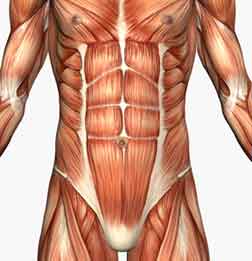
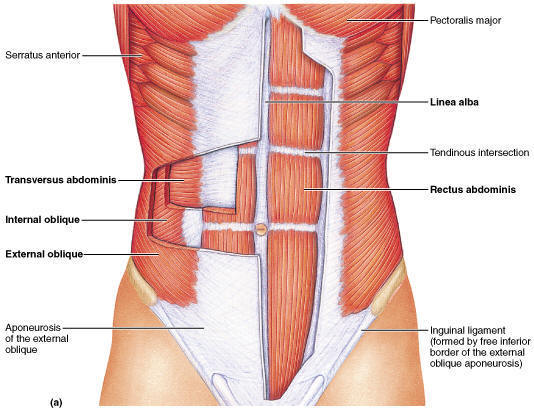
Internal & External Obliques

These muscle fibers run at an angle along from back to front and front to back respectively. While running these muscles help coordinate the upper and lower contralateral movements and help keep them synchronized. During swimming, these muscles help your body rotate smoothly and with control as you role from side to side with each stroke. These muscles are important in any side bending activity and help maintain the integrity of the spine.


Exercises to Use:

Side Plank


Side Plank with hip dips to the ground


Russian Twists

Bicycle Crunches

Oblique Crunches (any variation)


Transvers Abdominus

The transverse abdominus muscle is used in posture support for any position. (please see picture above). This muscle is often overlooked but can be strengthened through some of these exercises.


Exercises to Use:

Plank

Plank with leg lifts

The stomach vacuum

Lying

Transverse Pull ins

Back Extensions


Rectus Abdominus

This is the muscle of you probably thought of when you heard the word core or abdominals. Well this is an important muscle as well. It provides core strength and stability along with the other core muscles. This is also the muscle that provides that "6 pack" look when its strong and toned. It helps in biking, running and swimming in both postural support.

I'm sure you can think of at least 10 exercises that can work this muscle. However, here are a few fun ones to try.

Exercises to Use:

Pikes on Swiss Ball

Crunches on ball or disc

Reverse Crunches

Hanging Crunch

V-Ups

Rope Climber

Dead Bug

Training Recommendations

For Stomach Muscles - exercise each group at least 3x's per week for at least 3 sets of 20+ reps. Add weight slowly maintaining 20+ reps/set. Be careful how you add weight and never put yourself in a compromising position. In the beginning give yourself a day or two off in between. Once you build up strength and stamina you can work out every day.

Lower Back Muscles (including erector Spinae)- start with body weight of around 3-4 sets with 15-20 reps per set to start 2-3x's a week. Before you add weight increasing the frequency (meaning increase the number of days you use these exercises per week). Take 2-3 days off between exercising theses muscles.

Upper Back Muscles- start at a weight that allows you to complete 3 sets of 12-15 reps. You should feel fairly fatigued at the end of the set and very fatigued at the end of 3 sets. This would correspond with a weight that is about 65-80% of the max you could lift one time. As with the other exercises start with 2-3x's a week with at least 48 hours in between.

Saturday, June 2, 2012

Rule #1 - Listen to your body


Whether your egotistical or just a little insane some of us have this desire to see how far we can really go... Well let me tell you this thinking can get you into a lot of trouble. And I think I'm in  A LOT of trouble.

Last Saturday I ran 14 miles and did ok... I managed, but it was pretty slow. Before that my long distance running had been a bit sporadic, but despite that I felt fairly confident I could do at least 12 and 14 if I pushed it. So what did I do? I pushed it to see if I could do 14. SO I did what every good egotistical person would do I thought "you must be REALLY good" and decided to do push myself a little harder this week. Monday I ended up completely burning out practically all of my energy and the rest of the week I just did my best to hang on for my 16 miles this today. I ran loops around the Capitol building and Memorial Park. It was a really nice morning... until about 10 am when the sun came out full force and I was beat.

While my ego feels great that I just ran 16 miles... my legs are arguing a rather different story.

So what did I learn? Well #1 is to Listen to your Body and #2 I'm actually not superwoman. I know I know you're all shocked right?

So as it turns out our bodies are pretty good at surviving... In fact that's why we've lasted as long as we have. If it weren't for our bodies self defense mechanism that attempt to override the ego we'd have died ages ago. Our caveman ancestors would have all died while trying to see who could kill the biggest dinasour or something like that.

Survival takes a moderate amount of ego, common sense and a lot of attention to the cues your body is telling you. Its pretty easy to ignore the warning signs that your body is sending you until its too late and something drastic happens... like you pass out from dehydration or injured with a muscle strain. Or on the other end of the spectrum- when you ignore the signal to move you end up with a serious illness or disease like Metabolic Syndrom and Type II Diabetes.


5 Important Signals.

Practice listening to your body throughout the day and while exercising.  You can do this by pausing, analyzing the situation, look at yourself from inside out and ask yourself what do you really need?

1. Learn what Hunger really feels like. No I don't mean starve yourself. But do you know the difference between a craving/stress/emotional signal and a hunger signal? Most people don't.

2. Learn the difference between mental and physical fatigue. Physical fatigue is your body's way of saying I need more sleep or a rest. Mental fatigue is a way of saying I'm over stressed and your mind needs a break. Sometimes exercise can be a great "mental break" for your mind. So are activities like yoga and meditation.

3. Learn that the difference between stress and anxiety is simply how your mind intereprets the situation.

4. That restless feeling in the middle of the day? Your body wasn't built to sit around all day. Get up and move around.

5. Learn the difference in muscular sensations during exercise. It will help you know when to push on and when to stop. Not all sensations are bad, some are just stronger than others. Simply because your legs or lungs are burning doesn't mean you have to stop. But when you feel that muscle sensation (aka pain) that IS telling you to stop you need to listen.


Please help me by becoming a sponsor of my Run-A-Thon!!! See Run-A-Thon Event Details page on this blog for more info.

Thursday, May 31, 2012

Need Help Training?

So a friend made a very interesting suggestion that I'm going to try to follow through. His suggestion was that I share training tips, advice and help on the blog. I hope this would make the blog more useful to you? I want to encourage you all to please subscribe to and follow this blog so that you might become the reaper of all this soon to come good information!

Also, please post any questions or concerns you have about training, running swimming, biking, triathlons, or really... any other sport in the comments section on the blog or on my facebook page. I'd be more than happy to help in any way possible :0)

So to try out this idea I thought I'd simply share the workout that I did with my new-be swimmers in the pool this morning. The goal of the workout was to help them learn to swim freestyle with the focus on the proper arm motions.


To start...

50 yd flutter kick with kickboard. Face down in the water. Goal is to elongate the exhale and take big, but short inhales.

50 yd Sculling water- face down with a pull bouy between your legs so you won't kick. Practice skulling water in front of your head. Skulling means that you are developing a "feel" for the water. with arms extended straight over your head practice "opening the curtain" or pushing water out with the palms so your arms are in a "Y" shape, recover by brining your hands back into your original position. As you push out you should feel resistance against your palm but while bringing the hands back together try let them "slip" effortlessly through the water.

50 yd head up swimming- swim freestyle with head out of the water. Keep eyes straight ahead and focus on keep the elbows higher than the hands during both the recovery and arm pull

Repeat these until you are comfortable with the form and movement

Next

5 mins- holding onto the wall while kicking, practicing breathing while stroking with just one arm. Timing is key- practice turning the head to the side as you pull your arm back behind you. Imagine as you pull your arm back you are opening the door to inhale. As you close the door (move your arm forward) you should be done inhaling and your face should move back into the water.
***remember to look at the bottom of the pool and not in front of you.

50 yd Head up Head down. Swim half the pool with your head out of water and the second half with your head down trying to maintain the exact same form and rhythm with your head down that you had with your head up. when you need to breath try to breath into "the open door" meaning inhale as your arm is pulling behind you.

50 yd Single arm with kick board. Holding on to the kickboard with one hand use the other hand to take strokes. Try to breath into the open door. Elongate the exhale under water.


Please let me know if you have questions!